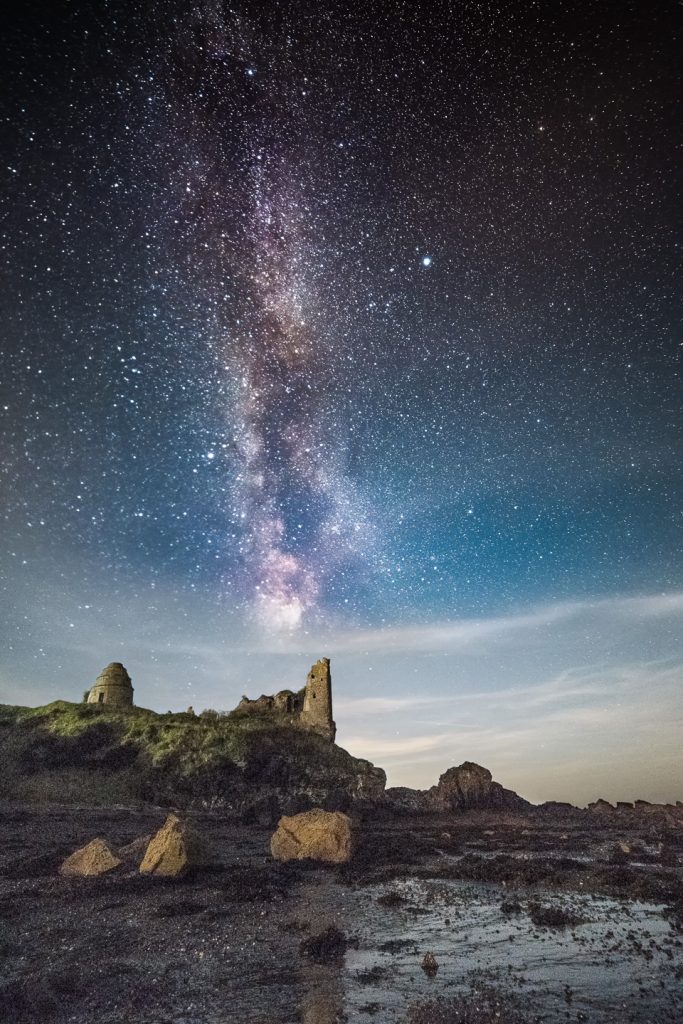
Dunure on the coast of South Ayrshire, Scotland is a regular ‘go to’ place for me to visit, I used to live a mere 25mins away so it was always fairly easy for me to go and visit whenever I felt like it.
A good 5 or 6 years ago I found myself in the fortunate position of visiting Dunure on a crystal clear night, and for maybe what was the first time in my life, I noticed the Milky Way looming overhead. Sure I’d have seen the Milky Way before, but I had never really ‘seen’ it. The sheer size of it 13.772 billion years in the making.
It was probably then that I had the idea of trying to capture a shot of the Milky Way passing behind the ruined tower of Dunure Castle. Now I am not saying that I was the first person in the world to ever think of such a shot, I am absolutely sure that I wasn’t, but at that point in my life I had never seen anyone else photographing it. So I parked at the harbour, got my camera gear from the rear of my car and I headed off down onto the beachfront.
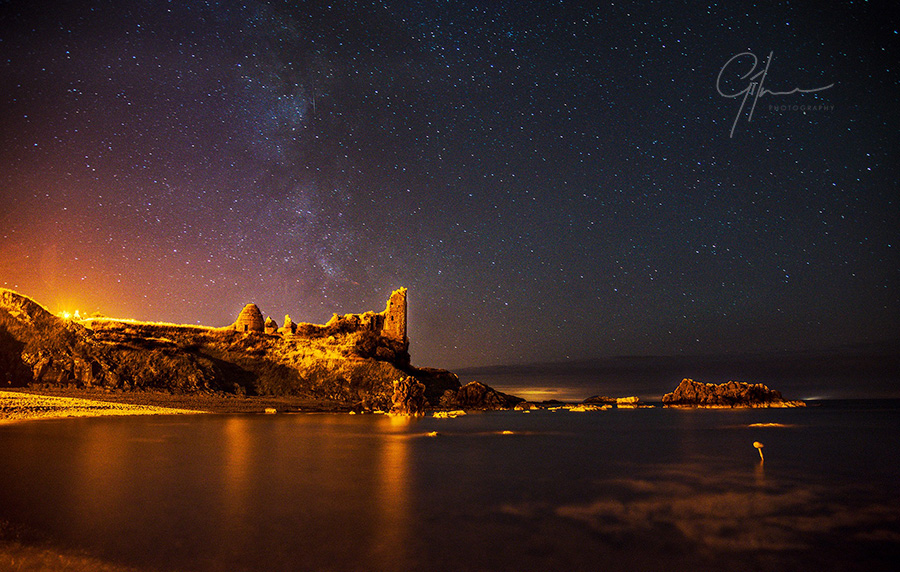
Now at this point in my blog I could go on and tell you about the shoot and how it went, but I won’t as this isn’t what this entry is about. Needless to say I got the shot I was after and I was very happy with the results and with myself.
See image to the left
3 years later and I am collating my photos looking for images to be used for a magazine and I stumble upon my shot of the Milky Way and Dunure Castle. “Oh now this would be a great shot to use!” I thought to myself, however upon further digging I found that I was unable to find the original RAW file of my photo anywhere, it was gone, absolutely nowhere to be found. Kicking myself I decided “Well I am just going to need to take the photo again!”. If only it was that easy.
I had to wait 3 years for the right conditions to take the shot again… 3 YEARS!!!
The Milky Way, or the Milky Way Core to be more specific, is only really visible in Scotland between the months of April and September. “Six months? That sounds like plenty of time to get the shot again, so why did it take you so long?” I hear you all say.
Well there are a few reasons why:-
First of all the best time to take a photo of the Milky Way is during a period of the night called ‘Dark Skies’, it’s when the sky is at its darkest (it’s not just a clever name). But during the summer in Scotland the night sky doesn’t really get dark dark, the sun doesn’t set till about 22:30 and then it rises about 03:30, in the five hours in-between the suns presence can still be seen as light blue glow on the horizon so the sky never truly gets dark dark. So straight away that is three of those six months that I personally rule out as the sky isn’t as dark as it could possible be. Afterall, the darker the sky, the brighter the stars.
Out of the remaining three months that are left there are only really three real opportunities to get the shot. Why just three you may ask? Well there are only three New Moons during that time. The moon pollutes the night sky with light like nothing else, so it’s best to take your shots during the New Moon phase of the lunar cycle when the moon is completely dark. Because… the darker the sky, the brighter the stars.
Then lastly consider the fact that I live in Scotland, a country of outstanding beauty, but it probably rains here more than it doesn’t. So factor in the chances of getting clear skies, on at least one of those all important three moon cycles and then hopefully you can start to see why it has taken me so long to get my shot.
About the shot
The opportunity to see the Milky Way Core shortens in Scotland as we get closer to the end of the year, so after three years I was getting desperate not to let another year go by without getting the shot. In-fact on the night this photo was taken the core was to be visible only for approximately 4 mins.
These 4 precious minutes were sandwiched perfectly between when Dark Skies began and before the Moon-rise 10 mins later. It was kismet
The timing of my shot was going to be crucial.
Overall I am happy with the shot but I plan to try again next year when hopefully there won’t be that bank of cloud over Turnberry and Girvan reflecting the light from the streetlights, and as a result I should be able to see more of the Milky Way Core.
Top Tips for Astrophotography
There are a few essential rules that you will need to know beforehand to be able to take a good photo of the Milky Way, these are…
1) Shoot somewhere dark, the less light pollution the brighter the stars will appear.
2) Use the fastest lens you own, preferably f/2.8 or faster.
3) Shoot with the lens aperture as open as it will allow, as you are trying to capture as much light as possible (e.g. If you have a f/2.8 lens, shoot f/2.8… if you have f/4, shoot f/4).
4) Shoot high ISO, preferably between 3200 and 5000. Anything more may make the photo too ‘noisey’.
5) Use a wide angle lens if possible. It will allow you to capture more of the Milky Way and increase your exposure time without the stars starting to ‘trail’. The longer the exposure time, the more light hits your sensor. The more light hits the sensor, the brighter the image.
6) Always shoot RAW!!!
No photographer’s Milky Way shot ever comes out looking like my photo. It’s only through editing the photo in Lightroom and Photoshop that we are able to start to pull out the detail that exists only in a RAW file.